
Table of Contents
- Introduction
- What Are Puns? A Clear and Funny Explanation
- Classic Examples of Puns Everyone Knows
- Examples of Puns by Category — Food, Animals, and More
- Examples of Puns in Literature and Pop Culture
- Short Pun Examples Perfect for Social Media
- Examples of Puns for Every Occasion
- Advanced Pun Examples for the Seriously Witty
- How to Write Your Own Puns — With Examples
- FAQ
- Conclusion
Introduction
Examples of puns are the foundation of one of the most beloved and widely practiced forms of humor in the English language — and this guide is the most complete collection of pun examples you will find anywhere online. Whether you have always loved wordplay and want a fresh collection to work from, you are trying to understand how puns work so you can create your own, you are a teacher looking for examples of puns to share with students, or you simply want to read hundreds of genuinely clever and funny lines organized in one place, this article delivers everything you need and more.
Puns are not just jokes — they are evidence of a sharp, playful mind that understands language deeply enough to find the hidden connections between words. The best examples of puns make you laugh and make you think at the same time, and that combination is genuinely rare in humor. A well-crafted pun rewards the audience for their language knowledge, surprises them with an unexpected connection, and creates that uniquely satisfying groan-laugh that only funny wordplay produces. With over 100 original and classic pun examples organized by type, category, occasion, and complexity level, this is your definitive guide. So get comfortable — class is in session and puns are the curriculum.
What Are Puns? A Clear and Funny Explanation {#what-are-puns}
The Definition and Mechanics of Wordplay
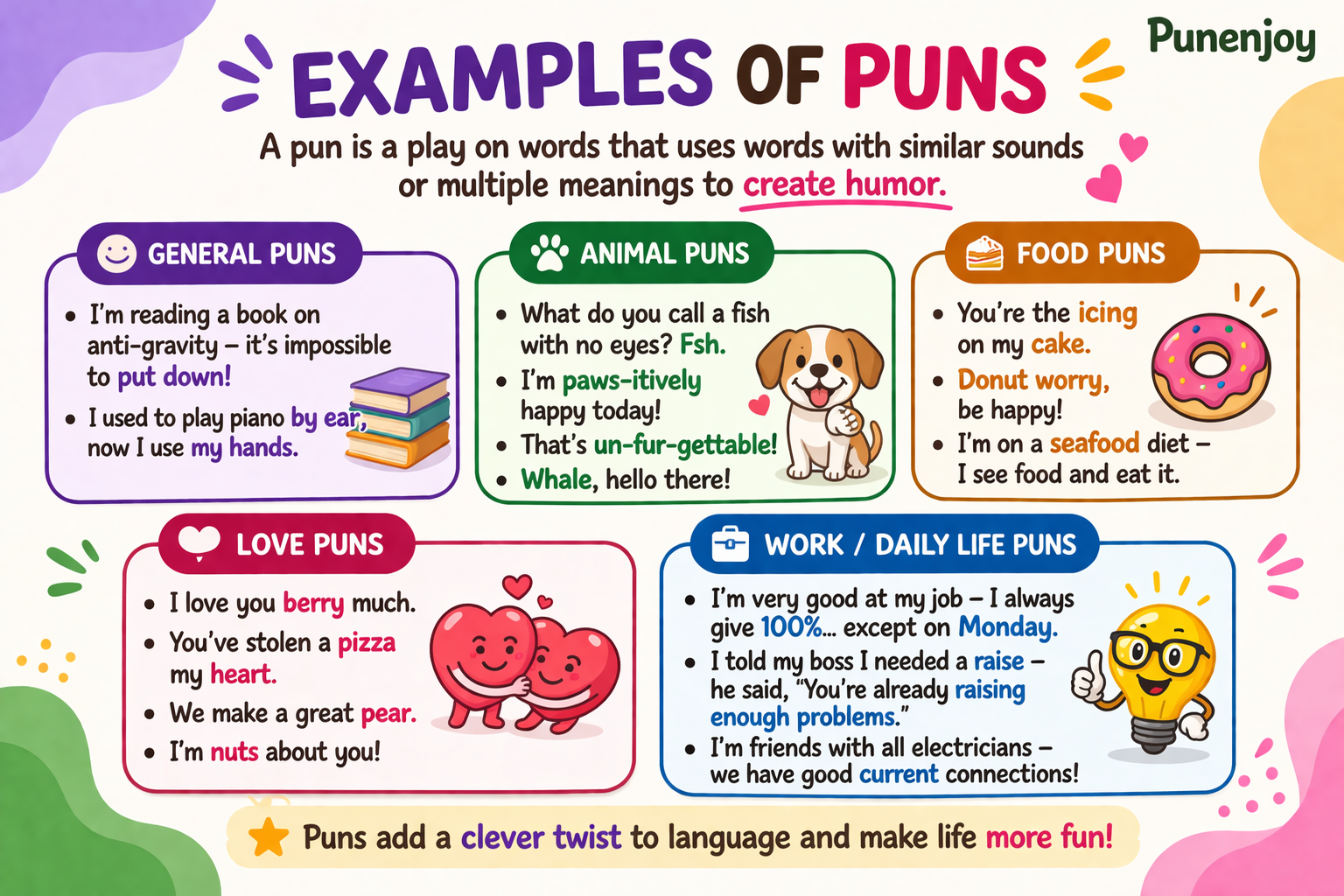
Before diving into examples of puns, it helps to understand exactly what makes a pun work. A pun is a form of wordplay that exploits two or more meanings of a word, or the similar sounds of two different words, to create humor. The comedy comes from the audience recognizing both meanings simultaneously — that moment of “wait, that works on two levels” is the punchline.
There are several types of puns, each working slightly differently:
Homophonic Puns use words that sound alike but have different meanings:
- “I used to be a banker, but I lost interest.” (Interest = financial interest AND enthusiasm)
- “Time flies like an arrow. Fruit flies like a banana.” (Flies = passes quickly AND the insect)
Homographic Puns use words that are spelled the same but have different meanings:
- “A bicycle cannot stand on its own because it is two-tired.” (Two-tired = having two tires AND being too tired)
- “I am reading a book about anti-gravity. It is impossible to put down.” (Put down = set aside AND the phrase meaning to criticize)
Compound Puns combine multiple wordplay elements in one joke:
- “I tried to write a joke about time but I ran out of time. Now I am trying one about space but it needs more space.”
Visual Puns work based on something seen rather than just heard — but in written form, they use words that create strong visual images with double meanings.
Why Puns Are the Most Intellectually Satisfying Form of Humor
Research on humor cognition shows that puns activate more areas of the brain than most other joke types. When you hear a pun, your brain processes the initial meaning, recognizes the unexpected second meaning, and experiences a small cognitive reward for catching the connection. That reward — the “aha” moment — is what produces the laugh (or the groan, which is really just a disguised laugh).
Puns also demonstrate linguistic intelligence. The ability to create good examples of puns requires deep vocabulary knowledge, awareness of word origins, and the creativity to spot unexpected connections. That is why pun makers are often the sharpest people in the room — even when the joke itself is deliberately terrible.
Classic Examples of Puns Everyone Knows {#classic-pun-examples}
The Greatest Puns of All Time
These are the most celebrated, most widely recognized examples of puns in the English language — the ones that have been making people laugh and groan for decades.
The All-Time Classic Pun Examples:
- “I used to be a banker but I lost interest.” — The perfect homophonic pun. Interest works in both contexts with zero strain.
- “Time flies like an arrow. Fruit flies like a banana.” — Groucho Marx’s masterpiece. The reinterpretation of every word in the second sentence is extraordinary.
- “I am reading a book about anti-gravity. It is impossible to put down.” — Elegant, clean, and perfectly constructed.
- “A bicycle cannot stand on its own because it is two-tired.” — Simple, immediately recognizable, universally beloved.
- “I stayed up all night wondering where the sun went. Then it dawned on me.” — The timing is built into the joke itself.
- “I used to hate facial hair, but then it grew on me.” — The slow revelation of the double meaning is perfectly executed.
- “I am on a seafood diet. I see food and I eat it.” — One of the most-used puns in history. Still works every time.
- “Why do cows wear bells? Because their horns do not work.” — The subverted expectation lands cleanly.
- “A skeleton walks into a bar and orders a beer and a mop.” — The visual punchline is the whole joke.
- “I tried to catch some fog earlier. I mist.” — Simple sound-alike perfection.
More Classic Pun Examples:
- “The man who survived both mustard gas and pepper spray is now a seasoned veteran.” (Seasoned = experienced AND covered in seasonings)
- “I was wondering why the baseball was getting bigger. Then it hit me.” (Hit me = understood AND physically struck)
- “What do you call a fake noodle? An impasta.” (Impasta = imposter + pasta)
- “I would tell a chemistry joke but I know I would not get a reaction.” (Reaction = response AND chemical reaction)
- “I used to be a doctor but then I lost patience.” (Patience = virtue AND patients = clients)
Examples of Puns by Category — Food, Animals, and More {#pun-examples-by-category}
The Best Pun Examples Organized by Subject
Food Pun Examples:
- “Lettuce celebrate — this moment is a big dill.” (Lettuce = let us / dill = deal)
- “I donut know what I would do without you.” (Donut = do not)
- “You are one in a melon.” (Melon = million)
- “That is soy good.” (Soy = so)
- “Orange you glad to see me?” (Orange = aren’t)
- “I am nuts about you.” (Nuts = crazy about)
- “We make a great pear.” (Pear = pair)
- “Life is short, eat the pasta. You will never regretti.” (Regretti = regret + spaghetti)
- “I baked you some pi.” (Pi = π mathematical constant)
- “Olive you so much.” (Olive = all of)
Animal Pun Examples:
- “What do you call a sleeping dinosaur? A dino-snore.” (Dino-snore = dinosaur + snore)
- “Why do cows go to New York? To see the moosicals.” (Moosicals = musicals + moose)
- “That is un-bear-able.” (Un-bear-able = unbearable + bear)
- “I am lion if I say I am not impressed.” (Lion = lying)
- “Toucan play at that game.” (Toucan = two can)
- “You are a real hoot.” (Hoot = owl sound AND something funny)
- “That joke is otter nonsense.” (Otter = utter)
- “I am pawsitively delighted.” (Pawsitively = positively + paw)
- “Don’t go bacon my heart.” (Bacon = breaking)
- “You had me at aloha.” (Aloha = hello in Hawaiian AND sounds like “a loha” of something)
Science and Math Pun Examples:
- “I would tell a chemistry joke but I know I would not get a reaction.” (Double meaning: response and chemical reaction)
- “Never trust an atom. They make up everything.” (Make up = create AND compose falsehoods)
- “What did the ocean say to the shore? Nothing — it just waved.” (Waved = wave of water AND to wave hello)
- “I used to be a math teacher but I had too many problems.” (Problems = math problems AND life issues)
- “Geology rocks but geography is where it is at.” (Rocks = geology study material AND slang for being great)
- “I am reading about electricity and I find it quite enlightening.” (Enlightening = informative AND electrical lighting)
- “Why was the math book sad? Too many problems.” (Problems = math AND emotional issues)
Nature and Weather Pun Examples:
- “I am going to become a meteorologist. I need to change whether I like it or not.” (Whether = if AND weather)
- “I was going to look for my missing watch but I could not find the time.” (Find the time = locate time AND have availability)
- “What did one tide say to the other? Nothing, it just waved.” (Waved = ocean wave AND friendly gesture)
- “I am a big fan of wind energy.” (Fan = enthusiast AND a fan that creates wind)
Examples of Puns in Literature and Pop Culture {#puns-in-literature}
When Great Writers Used Wordplay
Pun examples appear throughout the greatest literature in history — Shakespeare alone used thousands of puns, and the greatest comedic writers have always understood the power of layered wordplay.
Shakespeare’s Most Famous Pun Examples:
- In Romeo and Juliet, the dying Mercutio says “Ask for me tomorrow and you shall find me a grave man.” (Grave = serious AND cemetery)
- In Hamlet, “A little more than kin, and less than kind.” (Kind = type/family AND being kind/generous)
- In Richard III, “Now is the winter of our discontent / Made glorious summer by this sun/son of York.” (Sun/son — the dual meaning was intentional)
- In The Merchant of Venice, the play is built on puns around “bond” — financial bond AND emotional bond
Modern Pop Culture Pun Examples:
- The TV show “The Good Place” used puns constantly: the afterlife bureaucracy, the point system, the characters all operated on double meanings.
- Newspaper headlines are famous for brilliant puns: “Enraged cow injures farmer with axe” (whose axe?) — classic headline ambiguity
- The film “Grease” built its title on a double meaning — car grease AND slang for smooth/fast
- Many pharmaceutical drug names are carefully crafted puns on their function
Classic Literature Pun Examples:
- Lewis Carroll built Alice in Wonderland on nearly continuous wordplay — the Mock Turtle’s lesson in “Reeling and Writhing” (Reading and Writing), the “Drawling, Stretching, and Fainting in Coils” (Drawing, Sketching, and Painting in Oils)
- Charles Dickens used character names as constant puns: Mr. Bumble (pompous), Mr. Gradgrind (grinding down, grasping), Uriah Heep (creeping, heap of unpleasantness)
- Oscar Wilde’s entire comedic output was built on puns and epigrams: “I can resist everything except temptation” plays on the expected meaning of resist
Short Pun Examples Perfect for Social Media {#short-pun-examples}
Quick, Clever, and Ready to Share
The best examples of puns for social media are short, immediate, and require no explanation. Here is a collection organized by length and platform.
One-Word Setup Puns (Perfect for Captions):
- “I’m reading a book about mazes. I got lost in it.”
- “I told my doctor I broke my arm in two places. He told me to stop going to those places.”
- “My wife told me to stop acting like a flamingo. I had to put my foot down.”
- “I used to think I was indecisive, but now I am not so sure.”
- “I have a joke about construction but I am still working on it.”
Two-Line Pun Examples (Twitter Gold):
- “What did the janitor say when he jumped out of the closet? Supplies!”
- “Why do seagulls fly over the sea? Because if they flew over the bay, they would be bagels.”
- “What do you call a fake noodle? An impasta.”
- “I have a photographic memory but I always forget to put film in the camera.”
- “Why do we tell actors to ‘break a leg?’ Because every play has a cast.”
Examples of Puns for Every Occasion {#pun-examples-occasions}
Situational Pun Examples That Hit at the Right Moment
The best examples of puns are perfectly timed for their context. Here is how to use pun examples in specific situations.
Pun Examples for Birthdays:
- “Happy Birthday! You are not old — you are a vintage edition.”
- “Age is just a number. A very well-rounded number today.”
- “Another year wiser — or at least another year with more evidence to work from.”
Pun Examples for Work:
- “I would tell a joke about paper, but it is tearable.”
- “I excel at making spreadsheet jokes. They are right up my alley.”
- “The presentation went well — it had a great slide to it.”
Pun Examples for Romance:
- “Are you made of copper and tellurium? Because you are CuTe.”
- “I am no mathematician, but I am pretty good with numbers — and yours is at the top of my list.”
- “Are you a bank loan? Because you have my interest.”
Pun Examples for Teachers and Students:
- “The math teacher was arrested for plotting points in class.”
- “History teachers make the past tense.”
- “The English teacher was very comma-nding.”
Advanced Pun Examples for the Seriously Witty {#advanced-pun-examples}
Pun Examples That Reward the Sharpest Minds
These examples of puns require a bit more language knowledge to fully appreciate — they are the ones that make the most literate people in the room laugh loudest.
Multi-Layer Pun Examples:
- “Time flies like an arrow. Fruit flies like a banana.” — This works because “flies” is a verb in the first clause and a noun in the second, “like” is a preposition in both but means different things, and “time” and “fruit” swap between subjects and modifiers.
- “I am against hunting. In fact, I am a hunt-i-est.” — The “hunt-i-est” combines “anti” with “hunter” and plays on the suffix “-est” meaning most. Triple-layer construction.
- “Why does the Norwegian navy put bar codes on the sides of their ships? So when they return to port, they can Scandinavian.” (Scan-da-navian = scan the navy-an)
- “A man sued an airline company after it lost his luggage. Sadly, he lost his case.” (Case = lawsuit AND suitcase)
- “The grammarian was very tense.” (Tense = grammatical tense AND emotional state)
Classical and Literary Pun Examples:
- “Venison for dinner again? Oh deer.” (Oh deer = oh dear + deer = venison)
- “Did you hear about the mathematician who is afraid of negative numbers? He will stop at nothing to avoid them.” (Stop at nothing = nothing = zero)
- “I used to be addicted to soap but I am clean now.” (Clean = free from addiction AND physically clean from soap)
- “The cartoonist was found dead at home. Details are sketchy.” (Sketchy = suspect AND drawn in sketches)
- “A vulture boards an airplane carrying two dead raccoons. The flight attendant says ‘Sorry, only one carrion per passenger.'” (Carrion = carry-on AND rotting flesh)
How to Write Your Own Puns — With Examples {#how-to-write-puns}
The Complete Guide to Creating Puns, Illustrated With Examples
Understanding examples of puns is one thing — writing your own is the real art. Here is a complete guide.
Step 1: Find Words With Multiple Meanings
The foundation of every pun example is a word that works in two contexts. Start by listing common words with double meanings:
- Light = not heavy AND illumination
- Cool = temperature AND slang for good
- Rock = stone AND music AND to rock something
- Pitch = sales pitch AND musical pitch AND dark (pitch black)
- Break = pause AND to break AND lucky break
Step 2: Find Homophones (Words That Sound the Same)
Some of the best examples of puns use words that sound identical but mean different things:
- Sea/See, Knight/Night, Flour/Flower, Pear/Pair, Bare/Bear, Vain/Vein/Vane
Step 3: Build a Sentence That Works on Both Levels
This is the core skill. Write a sentence where the first reading is perfectly natural and the second reading surprises. The example: “I am reading about anti-gravity and I cannot put it down.” Both interpretations are equally valid and natural.
Step 4: Test the Setup
Say the pun out loud. Both meanings should click without explanation. If you have to explain it, the pun is not quite working yet. Trim until both meanings are immediately accessible.
Step 5: Study Great Pun Examples
The fastest way to improve at pun writing is to study great examples of puns and reverse-engineer them. Ask: what two meanings are at play? How does the sentence support both? What is the trigger word? Apply those patterns to new vocabulary.
FAQ {#faq}
Q1: What are examples of puns and what makes them funny?
Examples of puns are funny jokes and wordplay that exploit the double or multiple meanings of words, or the similar sounds of different words, to create humor. They are funny because the brain processes both meanings simultaneously and experiences a small cognitive reward — the “aha” moment of recognizing the connection. The best pun examples make the audience laugh AND think, which is a rarer and more satisfying comedic experience than jokes that only do one of those things.
Q2: What are the different types of puns with examples?
The main types of puns with examples include: Homophonic puns (words that sound alike — “I mist the fog joke”), homographic puns (words spelled the same with different meanings — “two-tired bicycle”), compound puns (multiple layers — “time flies/fruit flies”), and visual puns (based on images/descriptions). Each type creates the double-meaning effect through a different mechanism, but all deliver the same satisfying cognitive payoff.
Q3: Are puns considered good or bad humor?
Puns have a complicated reputation — some people love them passionately, others claim to hate them but still laugh. Research suggests that the groan response to a pun is actually a form of appreciation — the audience is acknowledging that the pun worked while expressing mock outrage at how obvious it was. Examples of puns from Shakespeare, Oscar Wilde, and Lewis Carroll prove that wordplay has always been considered the highest form of wit when done well. The “bad pun” is a genre — not a failure.
Q4: How can I get better at making puns?
The best way to improve at pun writing is to: study great examples of puns and analyze their structure, build your vocabulary (more words = more pun potential), practice spotting double meanings in everyday language, read widely (literature is full of excellent pun examples), and share your puns to learn which ones land. The more pun examples you expose yourself to, the more naturally you will start seeing the double meanings in language around you.
Q5: Where can I find more examples of puns and funny wordplay?
Right here at punenjoy.online! We have the most complete collection of examples of puns, funny wordplay, clever jokes, and all kinds of humor you can imagine. Bookmark the site, share this article with every pun lover and wordplay fan you know, and come back often for fresh content that keeps the laughs coming every single day.
Conclusion {#conclusion}
Examples of puns are the proof that language is one of the most playful, surprising, and endlessly rewarding tools human beings have ever developed. Whether you came here to understand what makes puns work, to build a collection of great pun examples for your own use, to find the perfect funny wordplay for a specific occasion, or simply to spend time in the company of the cleverest form of humor the English language has to offer — we hope this guide delivered everything you were looking for.
From classic pun examples that have stood the test of time to advanced wordplay that rewards the sharpest minds, from social media captions to literary examples from Shakespeare and Wilde, puns are endlessly creative, surprisingly intelligent, and genuinely worth mastering. With over 100 original and curated examples of puns in this collection, you are now fully equipped with all the wordplay knowledge and pun inspiration you will ever need.
So go ahead — share this article with every language lover, word nerd, and humor enthusiast in your life. Try one of these pun examples in your next conversation and enjoy the groan that proves you landed it perfectly. And whenever you need more funny wordplay, clever pun examples, and all the linguistic humor your vocabulary can handle, come right back to punenjoy.online — where the words always work on two levels and every visit is worth every meaning.
Because the best thing about examples of puns is that they prove language is endlessly more creative, more surprising, and more delightful than it first appears. And that is no pun intended — it is just the truth.
Published on punenjoy.online — Your #1 Source for Examples of Puns, Funny Wordplay, and Clever Humor